


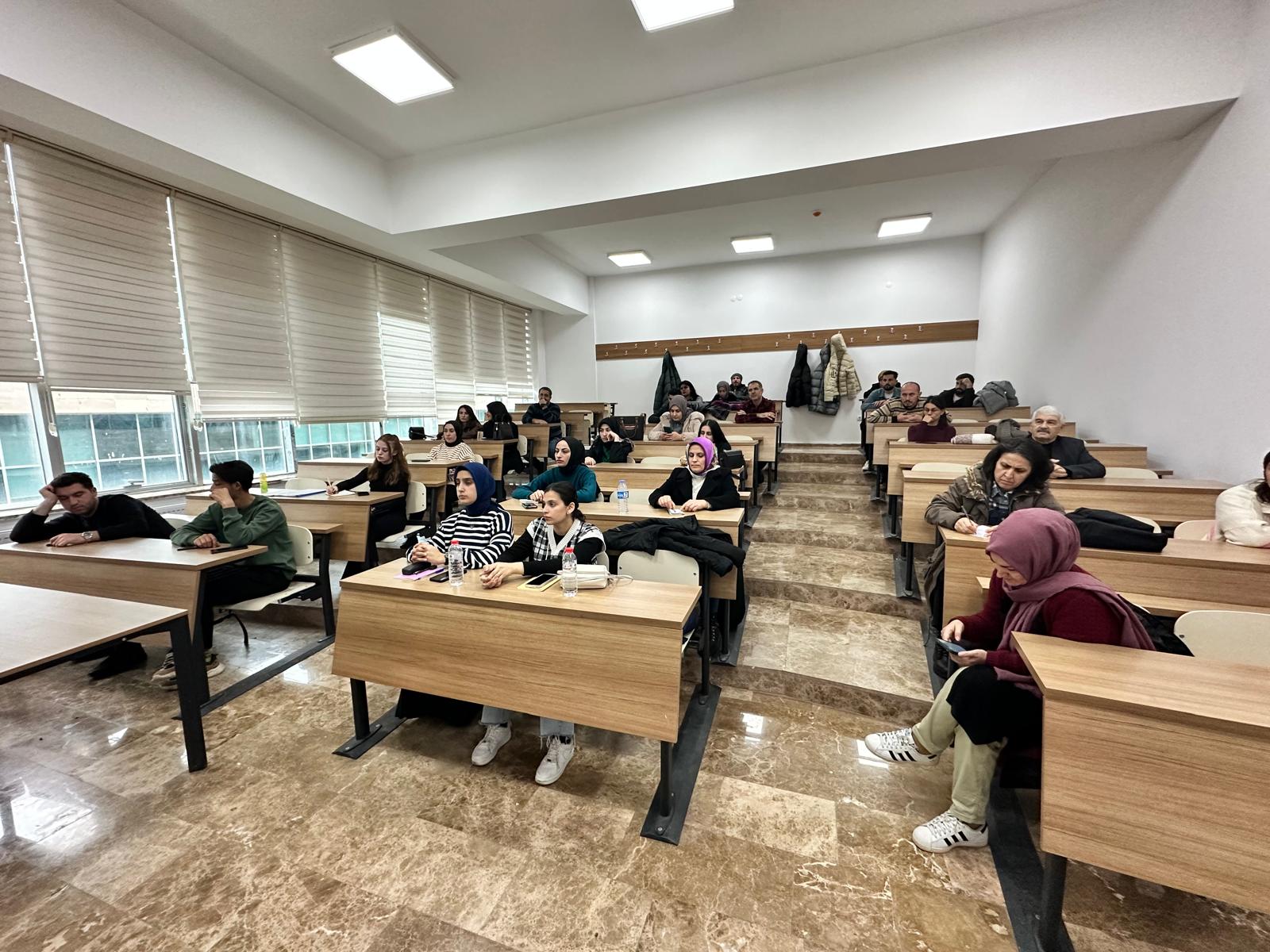

Our faculty member Assoc. Prof. Dr. Abdulsamet GÜNEK organized a seminar titled “Subject, Sovereignty and Communication in the Thought of Michael Foucault” upon the invitation of the Cinema and Literature Society at the Sociology Department of Muş Alparslan University. In the seminar, Assoc. Prof. Dr. Abdulsamet Günek examined in detail the transformation of Michel Foucault’s concepts of power and sovereignty throughout the historical process, the effects of these concepts on the subject, and the criticisms made to Foucault’s approach. Stating that Foucault’s understanding of power, unlike classical theories of power, is based on the analysis of power relations, Günek said that power is embodied through the institutions and relations it is affiliated with. Günek gave examples of how power relations are legitimized, manifest as a relationship of sovereignty, and ultimately transform the subject. Mentioning that the relationship between power and subject involves a reciprocal effect, Günek said, “The relationship between the subject and power is not always a one-way and uncanny power relationship. It is a mutual and transformative relationship, in a sense an interactive, symbiotic relationship that needs each other. In Foucault's power, the subject is the active subject,'' he said.
Günek, who stated that power relations include hegemony and resistance, said that especially modern Western powers that combine pastoral and police power understandings skillfully construct management relations with law and management strategies. Günek, who mentioned that power technologies and management strategies have an important place in Michel Foucault's analysis of power, stated that the use of punishment as a tool of power has been replaced by control through surveillance and control in the modern period. Günek, who gave the example of the panopticon, a prison construction model designed by the British philosopher Jeremy Bentham in 1785, said that according to Foucault, modern institutions such as prisons and hospitals have turned into self-control mechanisms.
Günek, who mentioned that Michel Foucault made a reference to ‘the death of man’ by referring to Friedrich Nietzsche, who was influenced by him in terms of thought, said that the subject has transformed and that there has been a transition from the management of bodies in bio-power to micro-power, and that now the management of souls has begun.
Günek, who also analyzed the criticisms directed at Michel Foucault’s thought, criticized that Foucault idealized Greek civilization in general, that his intellectual relationship with Eastern civilization was limited, and that his method was complex and difficult, based on his own readings. Günek, who mentioned that Foucault idealized the power relations in ancient Greece, while some thinkers such as Bernard Russel presented this as an example of political corruption, said that he was also criticized by some researchers for fragmenting and trivializing power.
The seminar, in which academicians and students actively participated, ended with a question and answer session.
 Muş Alparslan University

